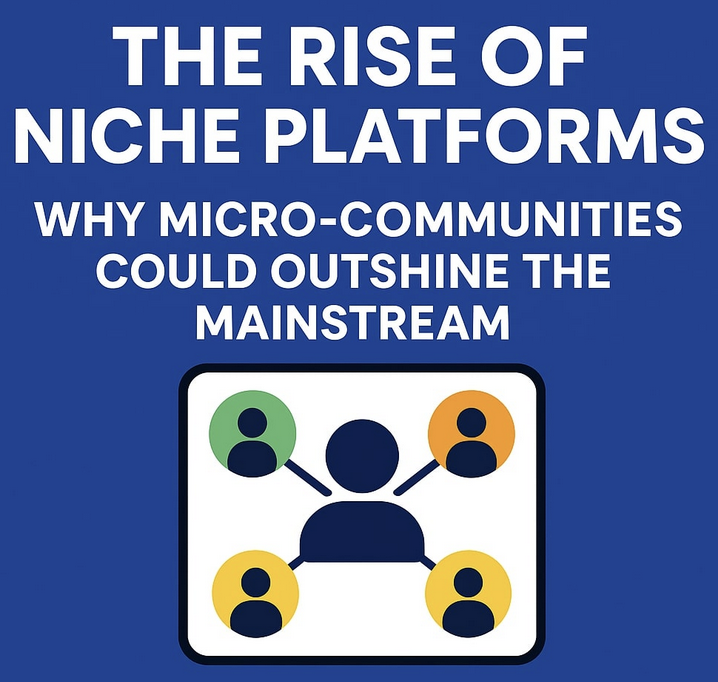
How Online Communities Reshaped Niche Interests
The internet has fundamentally changed how individuals connect, particularly for those whose interests fall outside mainstream visibility. What was once isolated has become networked, and what was once difficult to access is now readily available.
Before the rise of digital communities, discovering others who shared niche interests often depended on chance. People relied on small local networks, word of mouth, or rare physical gatherings. For many, this meant that entire parts of their identity or curiosity remained unexplored, not because of a lack of interest, but because of a lack of access.
The emergence of online communities shifted this dynamic completely. Early forums, message boards, and independent blogs created the first consistent spaces where people could connect across distance. These platforms were often simple in design but powerful in function. They allowed individuals not only to communicate, but to build ongoing conversations that developed over time.
As these communities grew, they began to form their own cultures. Shared language, norms, and expectations emerged organically, shaped by the participants themselves. This gave rise to environments where individuals could explore ideas more openly, supported by others who understood the context of those discussions. These environments have also shaped how people approach trust and communication in intimate exploration.
One of the most significant contributions of online communities has been the normalization of dialogue. Topics that once felt isolated or misunderstood became part of structured conversations. Questions could be asked without immediate dismissal, and experiences could be shared without the same level of scrutiny found in broader public spaces.
At the same time, these communities became informal centers of knowledge. Unlike traditional sources of information, which often present ideas in a fixed and authoritative way, online discussions allow for a more dynamic exchange. Perspectives are introduced, challenged, and refined through interaction. This process creates a form of collective understanding that evolves over time rather than remaining static.
The role of anonymity and pseudonymity has also been important. For many individuals, the ability to participate without revealing their full identity lowers the barrier to entry. It creates a space where exploration feels safer, particularly when engaging with topics that may still carry social stigma in offline environments.
However, this anonymity also introduces complexity. Without visible identity, communication relies more heavily on trust built through interaction. Communities often develop their own systems of credibility, where consistent participation and respectful engagement become markers of reliability.
As niche communities gained visibility, they began to intersect with broader digital culture. Social media platforms accelerated this process, bringing previously contained discussions into more public spaces. This shift created new opportunities for awareness, but it also introduced new challenges.
One of these challenges is the risk of oversimplification. When niche topics enter mainstream visibility, they are often reduced to easily digestible narratives. Nuance can be lost, and complex ideas may be misunderstood by audiences unfamiliar with their context. This can lead to misrepresentation, where the depth of the original discussion is replaced by surface-level interpretation.
Another challenge is the balance between openness and preservation. Communities that were once private or semi-private must decide how much of their space remains accessible and how much is protected. Increased visibility can bring growth, but it can also change the dynamics of the community itself.
Despite these challenges, the overall impact of online communities remains transformative. They have created spaces where individuals can connect beyond traditional limitations, explore identity with greater freedom, and participate in conversations that shape how culture evolves.
Perhaps most importantly, these communities have shifted the perception of what is considered “niche.” As more people engage with these spaces, the boundaries between niche and mainstream become less defined. What was once considered marginal becomes part of a broader spectrum of human experience.
In this sense, online communities are not just places of connection; they are active participants in cultural change. They influence how ideas are formed, how identities are understood, and how conversations develop over time.
As the digital landscape continues to evolve, so too will these communities. New platforms will emerge, old ones will adapt or disappear, but the underlying principle remains the same: the ability for individuals to find, engage with, and contribute to shared spaces will continue to shape how niche interests are understood and experienced.
The development of online communities has also been widely examined in broader internet studies and digital culture research, including work documented by sources like the Internet Society.